
The Hierarchy of Story Elements—What to Focus on When
Aka how to avoid polishing the paint on a car that has no engine
If you’ve been writing for a hot second, you’re well aware of the myriad of things that go (or ”are supposed to go”) into a story: character, setting, plot, scenes, one or more of dozens of story structures, probably kill your darlings, definitely show, don’t tell, and the list goes on. Even if you’ve finished a couple of stories or novels, the vastness of craft elements inherent in planning and writing a story can be intimidating. Enter: the Hierarchy of Story Elements chart. While this tool won’t magically spare you from the hard work of crafting a story, it will (hopefully) ground you and streamline the decision-making processes so you can more clearly focus on the creative choices that transform idea kernels into a story.
A Story is Like a Tree
To illustrate the principles of story construction, allow me to liken stories to trees. I’ve found this comparison works well for two main reasons:
One: Even if you know nothing about trees and can’t tell a maple apart from an ash tree, you can still tell if it’s a fine tree. You can see it has branches and leaves, and is rooted in the ground. On the flip side, if you spot a tree that has no branches and is precariously leaning to one side, its roots barely tethered in the ground, you can tell something is wrong. You again have no clue what tree it is or even what’s wrong with it, but you know something is off.
Stories are the same in that we can tell when they’re working fine and also when they’re not. But actually figuring out what’s wrong and why can be incredibly difficult if you don’t understand how they function (just like with trees!).
Two: Trees are interconnected systems. There are tens of thousands of different tree species in the world and despite their variety, they rely on similar elements to achieve their “tree-ness” – roots, water absorption, green leaves or needles for photosynthesis, etc.
Stories also come in near infinite shapes and sizes, but they all share elements that are interconnected and give them their “story-ness”. Here “interconnected” is the key word. Sometimes I’ve encountered writers who approach story elements as separate entities they can modify in isolation, not realizing that a change to one element impacts all the rest.
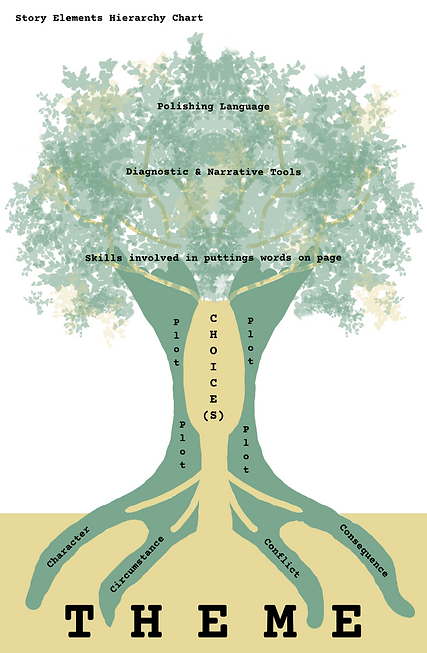
What to Focus on When
I’ve worked with writers who spent significant amounts of time revising the flow of their paragraphs before realizing that the entire premise of their work was flawed and needed a revision from the roots up—and that very few of those painstakingly polished sentences would be used in that revision. Throwing out unneeded parts of a story is almost an inevitable part of the creative process, but there is a difference between quick, productive detours and frustrating meandering that often leads to never finishing a story. The purpose of this tree analogy and its hierarchy framework is to help orient you to what elements of your story to focus on when. It helps you minimize wasted effort during your creative process and provides a structure that can guide you from start to finish.
The creation of your story will go most smoothly if you start by developing the most load-bearing story elements and proceed to the least load-bearing ones from there. Those elements are, in order:
-
theme
-
character, circumstance, conflict, consequence
-
plot
-
craft and revision tools, and skills related to putting words on the page
As the graphic illustrates, the theme is the soil that enables your story to stand. The characters, circumstances, conflicts, and consequences root the story and funnel the theme into the plot—which is the trunk. And finally, all is crowned with the skills and tools required to write clear, engaging prose that keeps your reader reading.
The analogy is simple in principle, though I’m of course not saying that pulling it all off is easy. The details of how to make the elements work and connect involve complexity and skill. In the next sections, I do a reasonably comprehensive deep-dive into each element, complete with examples to help you wrap your head around how to implement them in your story.